Wyoming FRNT - State Tracker

Wyoming FRNT • State Tracker
Wyoming became the first U.S. state to launch a publicly issued, fully reserved state-backed stable token through the Wyoming Stable Token Commission.
Status: 🟢 Launching / Live
The Frontier Stable Token (FRNT) represents the first operational example of a reserve-backed stable token issued under state legislation in the United States.
Wyoming's implementation provides the benchmark against which emerging state-backed stable token initiatives can be assessed.
FRNT Proof of Reserves
FRNT reserve information is publicly accessible through Chainlink Proof of Reserve, providing onchain visibility into reserve data supporting the token.
US Dollar (USD) total reserves at fair market value (FMV).
Published through the official Chainlink Proof of Reserve feed on Base.
Official Public Sources
StableTokens.com references official public sources relating to Wyoming's Frontier Stable Token (FRNT).
Wyoming Stable Token Commission
Official programme governance, public announcements, commission information, rules and documentation relating to FRNT.
Wyoming Stable Token Commission
Latest Verified Updates
October 2026.
- Wyoming continues operating the Frontier Stable Token (FRNT), America's first publicly issued state-backed stable token.
- The Wyoming Stable Token Commission has adopted Chainlink Proof of Reserve, strengthening public visibility into FRNT reserve and token-supply data.
- FRNT uses Chainlink CCIP for cross-chain interoperability following the Commission's review of its blockchain infrastructure.
- Public reserve transparency has continued to develop alongside FRNT's operational infrastructure and governance.
Last updated: September 2026.
Why FRNT Is Different
Most stablecoins are issued by private companies that maintain reserves supporting the tokens they circulate.
Wyoming introduced a fundamentally different model: digital money issued through an official public programme operating under state law.
Every FRNT is designed to remain backed by U.S. dollar-denominated reserves held under rules established by Wyoming's statutory framework.
Oversight is provided by the Wyoming Stable Token Commission, while institutional infrastructure providers support reserve management, blockchain operations and interoperability.
The distinction may appear subtle, but it changes the conversation entirely.
Private stablecoins represent corporate financial products. FRNT represents public financial infrastructure.
Instead of asking only whether private companies can issue digital dollars responsibly, Wyoming demonstrates how a public entity can issue reserve-backed digital money within a statutory governance framework.
That moves the discussion beyond cryptocurrency markets and into the world of public finance.
Reserve Transparency
Reserve backing is central to the FRNT model.
Wyoming's reserve framework requires assets supporting issued tokens to be managed according to rules established by the Wyoming Stable Token Commission.
FRNT is not backed by the full faith and credit of the State of Wyoming. Under the Commission's reserve rules, it constitutes a special obligation limited to the assets held within the relevant trust accounts.
Public reserve transparency provides an additional layer of accountability by allowing reserve information to be independently observed rather than relying solely on statements from the issuer.
This combination of statutory reserve requirements, public oversight and verifiable reserve information is one of the defining features of Wyoming's approach.
Building the Infrastructure for Public Digital Money
Launching a public stable token required more than legislation.
Wyoming assembled institutional infrastructure combining traditional financial controls with blockchain technology.
Reserve management, compliance, issuance infrastructure and blockchain interoperability form different parts of the FRNT operating model.
The Wyoming Stable Token Commission has also established policies governing how FRNT interacts with service providers and exchanges.
For example, the Commission's Listing Exchange Policy establishes procedures for monitoring platforms that list FRNT and describes compliance and risk-assessment requirements associated with participating service providers.
This institutional approach reflects a broader principle behind FRNT.
The technology is important, but governance is essential.
For Wyoming, blockchain is the infrastructure layer supporting a regulated public financial instrument.
Cross-Chain Infrastructure
One of the most significant areas of FRNT's development has been its approach to cross-chain interoperability.
The Wyoming Stable Token Commission reviewed the infrastructure used to move FRNT between supported blockchain networks and selected Chainlink's Cross-Chain Interoperability Protocol - CCIP - as part of its operational infrastructure.
The decision demonstrates an important characteristic of public-sector blockchain deployments.
Technology providers are not simply chosen because they enable blockchain functionality. Security, resilience, transparency and operational risk become public-policy considerations.
For a publicly issued digital financial instrument, infrastructure security becomes part of public governance.
Wider Tokenization, Being Explored
Wyoming is examining whether its state digital asset framework could expand beyond FRNT into a broader range of government-issued digital assets.
The Wyoming Legislature's 2026 interim work includes consideration of real-world asset tokenization, yield-bearing stable tokens and a potential restructuring of the Wyoming Stable Token Commission into a Wyoming Digital Asset Authority with broader responsibility for government-issued digital assets.
A current legislative working draft would give the proposed authority powers to issue, maintain and manage government-issued digital assets, including asset-backed tokens and yield-generating tokens.
Earlier proposals submitted as part of the Legislature's interim planning also identified the potential tokenization of real-world assets such as gold, livestock and oil, and proposed examining whether a state-based RWA programme could be feasible.
These developments remain under legislative consideration. Wyoming has not authorised or launched a state-backed commodity token, real-world asset token or yield-bearing stable token.
StableTokens.com therefore treats this as an emerging area of state-backed tokenization to monitor rather than an operational programme.
Current status: Legislative exploration
Current operational state-backed token: FRNT
Potential future scope: Real-world asset tokens, asset-backed tokens and yield-generating tokens
Last verified: 3 October 2026
Primary Sources
Wyoming Legislature, 2026 Final Interim Topic List
Priority 2: Wyoming Stable Token and Digital Asset Development. Wyoming Legislature
Wyoming Legislature, Wyoming Digital Asset Authority Working Draft
27LSO-0010, Working Draft 0.6. Wyoming Legislature
Wyoming Legislature, 2026 Interim Topic Proposals
Real-world asset tokenization proposal submitted by Wyoming Stable Token Commission Executive Director Anthony Apollo.
Public Money Meets Blockchain
Why would a state issue a digital dollar in the first place?
The answer is practical.
Blockchain-based dollars have the potential to support faster settlement, programmable transactions and new forms of digital payment infrastructure while retaining traditional reserve backing and legal oversight.
Potential applications for state-backed stable tokens could eventually include government payments, vendor settlement, treasury operations and other regulated financial transfers.
FRNT demonstrates that blockchain technology can be incorporated into public financial infrastructure without abandoning reserve requirements or government oversight.
This is not simply a conversation about creating new money. It is about changing how existing money can move.
Wyoming's Position in the U.S. Tracker
StableTokens.com currently classifies Wyoming as:
🟢 Launching / Live
This is the highest classification within the StableTokens.com methodology.
Wyoming qualifies because an officially authorised state-backed stable token has progressed beyond legislation, investigation and development into public issuance.
The distinction is important.
A state does not qualify simply because it regulates stablecoins, passes digital-asset legislation or considers blockchain technology.
StableTokens.com requires verified public evidence directly relevant to a state-backed stable token programme.
As of October 2026, Wyoming remains the benchmark.
A Small but Emerging National Picture
Wyoming's launch has inevitably raised a broader question:
Will other U.S. states follow?
North Dakota has now launched Roughrider Coin through a model governed by the state-owned Bank of North Dakota, with issuance by VersaBank USA.
New Hampshire is formally investigating stable token frameworks through a statutory commission.
Wyoming and North Dakota now represent two distinct operational approaches to state-backed digital money, while New Hampshire remains at the formal review stage.
Other states - including Texas and Pennsylvania - have significant stablecoin, digital-currency or digital-asset policy activity but currently do not meet StableTokens.com's threshold for a verified state-backed stable token programme.
That distinction is deliberate.
StableTokens.com separates state-backed stable token activity from broader stablecoin regulation, private issuance and digital-asset policy.
Why the Classification Matters
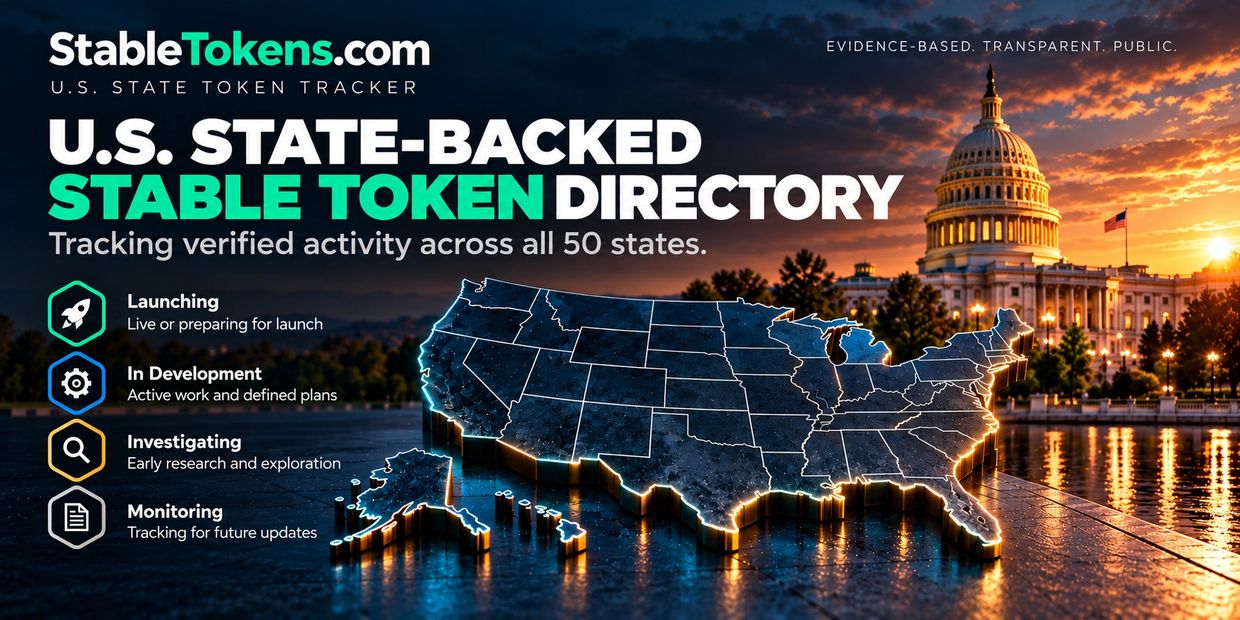
The StableTokens.com tracker uses four classifications:
🟢 Launching — an officially issued state-backed stable token has launched through an authorised public state programme.
🔵 In Development — verified state implementation, legislation or an official government programme is actively advancing toward issuance or launch.
🟡 Under Review — an official commission, study, working group or public process is formally exploring a potential state-backed stable token framework.
⚪ Monitoring — no verified public programme is currently advancing or formally investigating a state-backed stable token.
Wyoming provides the clearest example of what Launching means.
The classification reflects an operational public programme - not simply legislation or political interest.
Why StableTokens Exists
StableTokens.com was created to document the emergence of publicly issued and state-backed stable tokens in the United States.
The site is not designed to promote tokens or speculate on cryptocurrency markets.
Its purpose is to provide independent research, verified updates and a transparent record of how U.S. states approach public digital money.
Every State Tracker prioritises official legislation, commission records, treasury publications, government documentation and verified public announcements.
Our editorial approach is simple.
Evidence comes before headlines.
Transparency comes before hype.
Public finance deserves public facts.
The Road Ahead
Wyoming has moved state-backed stable tokens from theory into practice.
FRNT now provides a live case study in how public digital money can combine statutory authority, reserve backing, institutional financial infrastructure and blockchain technology.
The next stage will be determined by adoption, infrastructure development, reserve transparency, regulatory evolution and the response of other states.
StableTokens.com will continue monitoring:
- Wyoming Stable Token Commission activity;
- FRNT reserve transparency;
- blockchain and interoperability infrastructure;
- governance changes;
- public adoption and distribution;
- legislative developments;
- and significant operational milestones.
Every material update will be reflected in the Wyoming State Tracker when verified public evidence becomes available.
StableTokens.com - Founding Edition Declaration
StableTokens.com exists to document, explain and track the emergence of publicly issued stable tokens in the United States.
Every classification is based on official legislation, executive action, commission activity, treasury publications or government announcements.
Evidence-based. Transparent. Public.
Return to the U.S. State Tracker
Compare this state with verified state-backed stable token activity across all 50 U.S. states.
← Explore the Interactive U.S. State Tracker
Continue Exploring
- What Is a State-Backed Stable Token? - Learn Guide 001.
- Wyoming FRNT Explained - Learn Guide 002.
- State-Backed Stable Tokens vs CBDCs - Learn Guide 003.
- How Reserve Backing Works - Learn Guide 004.
- How States Launch Stable Tokens - Learn Guide 005.
- Explore the U.S. State-Backed Stable Token Tracker - Follow verified state-backed stable token developments across all 50 U.S. states.
- Stable Token Glossary - Reference Guide
© 2026 StableTokens.com. All Rights Reserved.