Texas - State Tracker

Texas • U.S. State Tracker
Texas is developing significant public digital-currency and stablecoin policy, including an authorised electronic payment framework backed by gold and silver held in the Texas Bullion Depository.
However, Texas has not announced or launched a state-backed stable token comparable with Wyoming FRNT or North Dakota's Roughrider Coin.
Status: ⚪ Monitoring - Related State Initiative
Texas therefore remains a closely monitored state within StableTokens.com's research, while its digital-currency initiatives are distinguished from verified state-backed stable token programmes.
Official Public Sources
Texas Legislature - HB 1056
HB 1056 recognises qualifying gold and silver specie as legal tender in Texas and authorises the Texas Comptroller to establish or authorise electronic systems enabling payments using currency backed by gold and silver bullion held in the Texas Bullion Depository.
View HB 1056 - Texas Legislature
Texas Legislature - SB 2922
SB 2922 proposed the Texas Oil-Backed Stablecoin Act, which would have created a regulatory framework for licensed issuers of stablecoins backed by oil or oil products.
View SB 2922 - Texas Legislature
Texas Department of Banking
The Department currently regulates issuers of fiat-backed stablecoins as money transmitters and is preparing Texas's regulatory approach under the federal GENIUS Act.
Texas Department of Banking - Stablecoin Regulation
Latest Verified Updates
September 2026
Texas's digital-currency landscape now includes several distinct developments.
HB 1056 has become law. The legislation authorises the Comptroller to establish or approve electronic systems through which depositors and vendors can make and receive payments using currency backed by gold and silver bullion held in the Texas Bullion Depository.
The legal-tender provisions took effect on September 1, 2026, while the broader transactional-currency provisions are scheduled to take effect on May 1, 2027.
Separately, Texas lawmakers considered legislation concerning oil-backed stablecoins, while the Texas Department of Banking continues developing its regulatory treatment of fiat-backed payment stablecoin issuers.
Last updated: September 2026
Why Texas Matters
Texas is an unusual case in America's emerging state digital-money landscape.
The state is not currently developing a conventional dollar-backed public stable token like Wyoming FRNT.
Instead, Texas has taken concrete legislative action around commodity-backed transactional currency.
HB 1056 gives the Comptroller authority to establish or authorise electronic systems that allow payments using currency backed by gold and silver bullion held in the Texas Bullion Depository.
That makes Texas highly relevant to StableTokens.com's broader research into how states are experimenting with digital forms of publicly supervised money.
But it does not, by itself, qualify Texas as a state-backed stable token programme under our methodology.
Texas's Gold and Silver Transactional Currency
HB 1056 represents the clearest verified state-level digital-currency development in Texas.
Under the legislation, the Comptroller may establish or authorise one or more electronic systems through which depositors or vendors can make and receive payments using currency backed by gold and silver bullion held in the Texas Bullion Depository.
The Comptroller may also contract with outside vendors to implement the system and must establish rules covering areas including transaction security, valuation, fees, authorised vendors and fraud prevention.
This is genuine public digital-money infrastructure.
However, its backing model is fundamentally different from the dollar and Treasury reserve model associated with conventional payment stablecoins.
Texas and Stablecoins
Texas is also active in stablecoin policy.
SB 2922 proposed creating a framework for an oil-backed stablecoin.
Under the proposal, authorised issuers would maintain oil or oil-product reserves supporting outstanding tokens, with the Texas Department of Banking responsible for licensing and oversight.
The important distinction is that the proposed issuer was defined as a person authorised by the Department - not the State of Texas itself.
For StableTokens.com's methodology, regulatory oversight of privately issued stablecoins does not automatically make a token state-backed.
Texas and the GENIUS Act
Texas is also preparing for the emerging federal payment-stablecoin framework.
The Texas Department of Banking states that it currently licenses and regulates fiat-backed stablecoin issuers as money transmitters under Chapter 152 of the Texas Finance Code.
The Department intends to continue regulating these entities consistently with the federal GENIUS Act and its implementing regulations.
Again, this represents stablecoin regulation rather than state issuance.
That distinction is central to the StableTokens.com tracker.
Why Texas Is Classified as Monitoring
StableTokens.com currently classifies Texas as:
⚪ Monitoring — Related State Initiative
Texas unquestionably has meaningful public digital-currency activity.
However, we have not identified sufficient verified evidence that Texas is currently issuing, implementing or formally investigating a state-backed stable token meeting the StableTokens.com definition.
Its activity currently falls into three related areas:
- commodity-backed public transactional currency;
- proposed regulation of commodity-backed stablecoins;
- regulation of privately issued fiat-backed payment stablecoins.
These developments deserve coverage, but they should not be conflated with direct state stable-token issuance.
A Different Path From Wyoming
Wyoming's FRNT provides a useful comparison.
FRNT is a publicly issued state stable token operating through an official state programme.
Texas's HB 1056 instead establishes authority for electronic transactional currency backed by gold and silver bullion held in the Texas Bullion Depository.
Both represent state-level innovation in money and payments.
They are nevertheless structurally different models.
Maintaining that distinction is exactly why StableTokens.com uses evidence-based classifications rather than grouping every digital-currency initiative together.
What StableTokens Is Monitoring
StableTokens.com will continue monitoring Texas for:
- implementation of HB 1056;
- rules issued by the Texas Comptroller;
- development of electronic bullion-backed payment systems;
- new state-backed stable token legislation;
- stablecoin legislation and regulatory developments;
- Texas Department of Banking activity;
- and any future programme involving direct state issuance.
If Texas establishes an official investigation or programme specifically directed toward a state-backed stable token, its classification can change.
Why StableTokens Exists
StableTokens.com documents the emergence of publicly issued and state-backed stable tokens using verifiable public evidence.
A state does not qualify as In Development merely because it regulates stablecoins, adopts blockchain legislation or develops other forms of digital currency.
There must be verified evidence that official state activity is advancing toward a state-backed stable token.
Evidence comes first.
Transparency comes before hype.
Public finance deserves public facts.
The Road Ahead
Texas is worth watching closely.
HB 1056 gives the state a concrete legislative foundation for commodity-backed electronic currency, while its regulators and legislators continue engaging with the rapidly evolving stablecoin market.
But as of September 2026:
⚪ Status: Monitoring - Related State Initiative
Key development: HB 1056
Model: Gold and silver-backed transactional currency
Public authority: Texas Comptroller of Public Accounts
Stablecoin activity: Regulatory and legislative
Verified state-backed stable token: None currently identified
Next milestone: HB 1056 transactional-currency provisions - May 1, 2027
StableTokens.com will update Texas's classification if verified public evidence supports a change.
StableTokens.com - Founding Edition Declaration
StableTokens.com exists to document, explain and track the emergence of publicly issued stable tokens in the United States.
Every classification is based on official legislation, executive action, commission activity, treasury publications or government announcements.
Return to the U.S. State Tracker
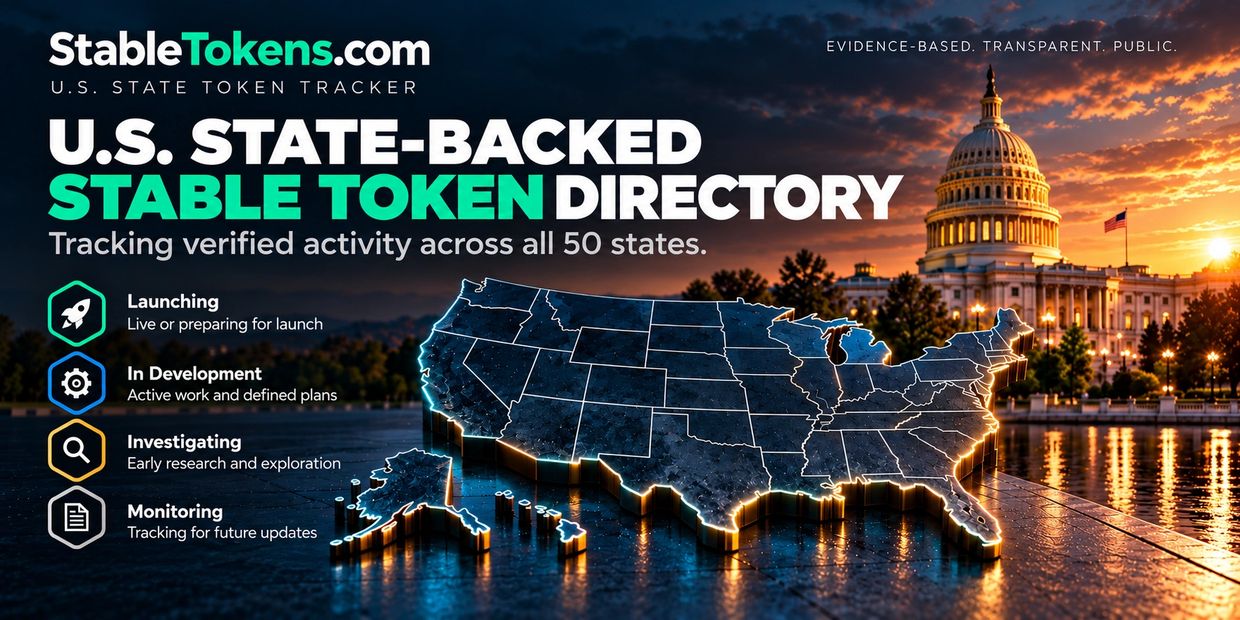
Compare this state with verified state-backed stable token activity across all 50 U.S. states.
← Explore the Interactive U.S. State Tracker
Continue Exploring
- What Is a State-Backed Stable Token? - Learn Guide 001.
- Wyoming FRNT Explained - Learn Guide 002.
- State-Backed Stable Tokens vs CBDCs - Learn Guide 003.
- How Reserve Backing Works - Learn Guide 004.
- How States Launch Stable Tokens - Learn Guide 005.
- Explore the U.S. State-Backed Stable Token Tracker - Follow verified state-backed stable token developments across all 50 U.S. states.
- Stable Token Glossary - Reference Guide
© 2026 StableTokens.com. All Rights Reserved.