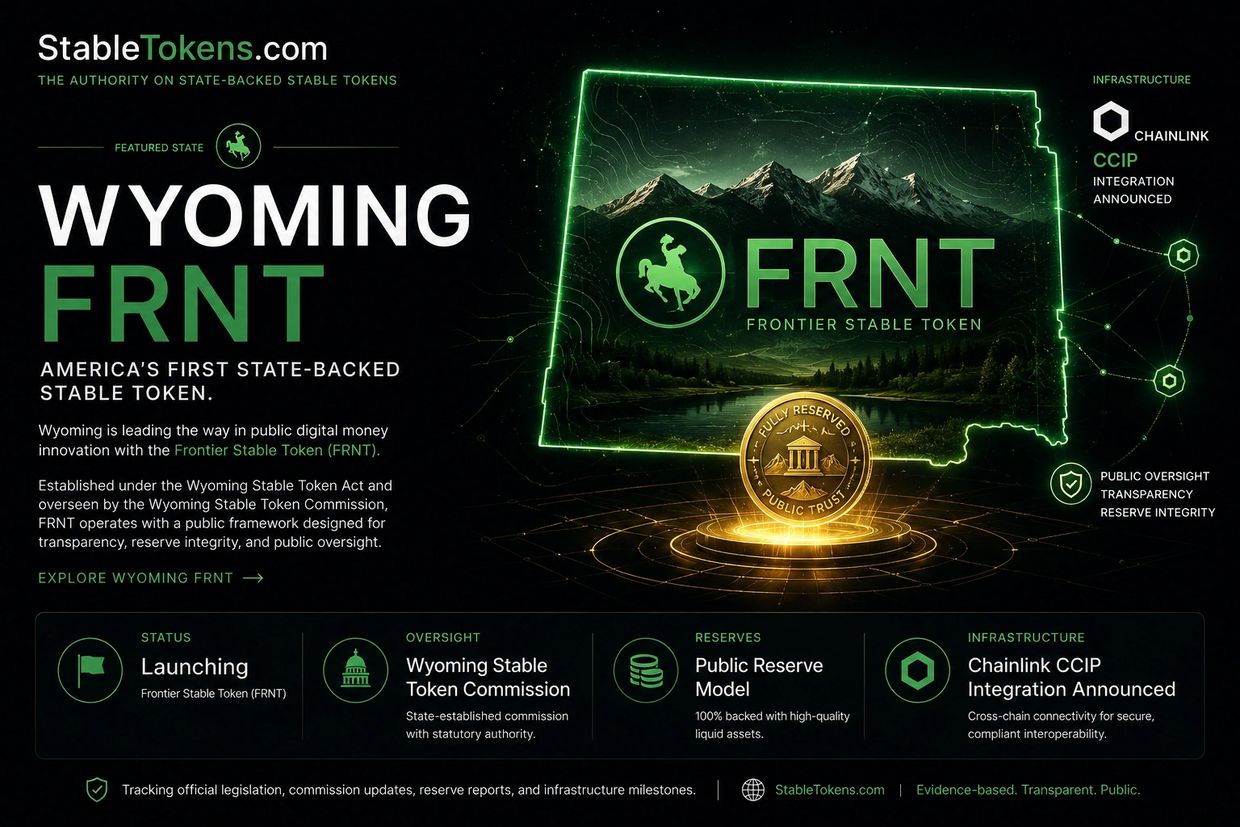
Featured State - Wyoming FRNT
WHY WYOMING FRNT COULD BECOME THE BLUEPRINT FOR AMERICA'S DIGITAL DOLLAR
An editorial feature from StableTokens.com
Reading time · Approximately 10 minutes
Publication · Founding Edition — August 2026
Editorial Desk · StableTokens Research
Sources · Wyoming Stable Token Commission, official legislation, public treasury records and government announcements.
Editorial Standard
Evidence-based. Transparent. Public.
Why FRNT Is Different
Most stablecoins today are issued by private companies that hold reserves supporting the tokens they circulate. Wyoming’s model introduces something entirely new: public digital money issued under a statutory framework.
Every FRNT is designed to remain backed by U.S. dollar-denominated reserves held under rules established by Wyoming law. Oversight is provided by the Wyoming Stable Token Commission, while institutional infrastructure partners support reserve management and blockchain operations.
The distinction may appear subtle, but it changes the conversation entirely.
Private stablecoins represent corporate financial products. FRNT represents public financial infrastructure.
Instead of asking whether cryptocurrency companies can issue digital dollars responsibly, Wyoming asks whether governments can issue digital dollars transparently.
That shift moves stablecoins into the world of public finance rather than speculative crypto markets.
Building the Infrastructure for Public Digital Money
Launching a public stable token required more than legislation. Wyoming assembled an institutional infrastructure that resembles traditional financial markets more than a typical blockchain startup.
Reserve management is handled through institutional partners. Blockchain infrastructure providers support issuance, custody, and interoperability. Multiple public blockchain networks have been tested as part of Wyoming’s deployment strategy, allowing FRNT to operate as digital payment infrastructure rather than remaining tied to a single ecosystem.
This institutional approach reflects a broader philosophy behind FRNT. The technology is important, but governance is essential.
For Wyoming, blockchain is not the destination. It is the infrastructure layer supporting regulated public payments.
The Security Decision That Changed Everything
One of the most significant moments in FRNT’s development came when Wyoming reassessed its cross-chain infrastructure.
Following an extensive security review, the Wyoming Stable Token Commission announced that FRNT would migrate its interoperability infrastructure to Chainlink’s Cross-Chain Interoperability Protocol (CCIP). The decision highlighted a growing trend among public-sector blockchain projects: infrastructure is increasingly evaluated using security, resilience, and operational standards similar to those used in banking systems.
This was not simply a technology upgrade. It demonstrated that governments are beginning to treat blockchain infrastructure as critical public infrastructure.
Security became public policy.
That decision may ultimately become one of the defining moments in the evolution of state-backed stable tokens because it established a precedent for how governments evaluate blockchain networks.
Public Money Meets Blockchain
Why would a state issue a digital dollar in the first place?
The answer is surprisingly practical.
Digital dollars have the potential to modernise government payments, vendor settlements, treasury operations, tax payments, and other forms of regulated financial transfers. Rather than replacing existing payment systems, state-backed stable tokens could become a faster, programmable layer built on top of them.
FRNT demonstrates that blockchain technology can be integrated into public financial infrastructure without abandoning traditional reserve models or legal oversight.
This is not a conversation about replacing money. It is a conversation about improving how money moves.
The Beginning of a National Conversation
History suggests that financial innovation often begins in individual states before influencing national policy.
Banking regulation, corporate law, securities legislation, and digital asset frameworks have frequently emerged at state level before shaping federal discussions.
Wyoming’s FRNT raises an important question.
If one state successfully demonstrates regulated public digital money, will other states begin building similar frameworks?
Several states have already introduced legislation, commissioned studies, or opened official discussions exploring state-backed stable token initiatives. StableTokens.com tracks those developments independently through official legislative records, treasury publications, commission activity, and government announcements.
Our State Tracker exists for one reason: separate verified public policy from speculation.
Every state is monitored continuously. Every classification is evidence-based.
Wyoming remains the benchmark against which every future initiative is measured.
Why StableTokens Exists
StableTokens.com was created to document one of the most important developments in modern public finance: the emergence of state-backed stable tokens in the United States.
The site is not designed to promote tokens or speculate on cryptocurrency markets. Its purpose is to provide independent research, verified updates, and a transparent record of how U.S. states are approaching public digital money.
Every article is written using official legislation, commission announcements, treasury publications, and government sources wherever possible.
Our editorial approach is simple.
Evidence comes before headlines.
Transparency comes before hype.
Public finance deserves public facts.
The Road Ahead
Wyoming has not solved the future of digital money.
It has done something arguably more important.
It has created the first live public experiment in state-issued, fully reserved digital dollars within the United States.
Whether FRNT remains a Wyoming success story or becomes the blueprint for other states will be determined over the coming years through legislation, infrastructure decisions, public adoption, and institutional trust.
What is already clear is that the conversation around stable tokens has changed.
It is no longer only about cryptocurrency companies.
It is increasingly about governments, legislation, payment infrastructure, and the future of the U.S. dollar in a digital world.
StableTokens.com will continue documenting that story as it unfolds—across every state, every commission meeting, every bill, and every verified milestone.
StableTokens Founding Edition Declaration
StableTokens.com exists to document, explain, and track the emergence of publicly issued stable tokens in the United States.
Every classification is based on official legislation, executive action, commission activity, treasury publications, or government announcements.
Evidence-based. Transparent. Public.